The Hook: Trust is the Bottleneck
We have all seen agents write code or summarize a 50-page document in seconds. But when applied to deep research—whether in medical science, regulatory compliance, or enterprise intelligence—most agents hallucinate, drop critical context across documents, and fail to deliver verifiable proof. The core bottleneck in enterprise AI is never text generation; it is verifiable trust.
I. THE DEEP RESEARCH GAP: DEMO VS. DEPENDABLE
A standard research demo looks magical on stage: 40 sources cited, 2,000 words generated, perfectly formatted prose, and total confidence. But run that same prompt twice and you often get two conflicting answers. Citations point to entire PDFs without pinpointing text spans, and the model glibly bridges logic gaps with synthetic assertions.
Before an enterprise reviewer, clinician, or auditor accepts a deep research output, the system must shift from a confident guesser to a verifiable graph engine:
| A Research Demo Shows… | A Dependable Agent Delivers… |
|---|---|
| Vague, cosmetic citations at the footer | Claim-level citations resolving to an exact span [doc#chunk] |
| Single-shot vector lookup (top-k chunks) | Multi-hop reasoning chains auditable hop-by-hop across disconnected documents |
| Nondeterministic traces (different paths per run) | Deterministic traversals — same inputs trace through the same subgraph |
| Fabricates plausible bridges when data is missing | Strict refusal — explicitly returns "no verified relationship found" |
| Unchecked autonomous execution | Human-at-the-stake-line before commits, actions, or clinical decisions |
II. WHY BASELINE RAG BREAKS ON DEEP RESEARCH
Baseline RAG (chunk → embed → top-k vector similarity → prompt synthesis) is cheap, fast, and stands up in an afternoon. For single-fact lookups ("What is our cancellation policy?"), it is difficult to beat. But for deep research questions, baseline RAG suffers from two fundamental architectural flaws:
- Chunk boundaries sever vital relationships: When splitting documents into arbitrary token windows (e.g., 512 or 1024 tokens), interconnected facts end up in different chunks. If Fact A is in Chunk 1 and Fact B is in Chunk 4, vector similarity rarely retrieves both unless both independently match the semantic query vector.
- Similarity is not logical inference: Cosine similarity retrieves what sounds like the prompt, not what connects the evidence. Top-k retrieval gives the LLM disjointed text snippets without the relational schema needed to trace causal, hierarchical, or regulatory dependencies.
The fix is a hybrid architecture: extract explicit entities and relationships into a Knowledge Graph, connect every node back to its source text chunk, and execute graph traversal combined with vector search.
III. THE REFERENCE IMPLEMENTATION: VERITASGRAPH
To ground this in production code, this build utilizes VeritasGraph — an open-source GraphRAG framework designed for high-stakes, auditable research environments.
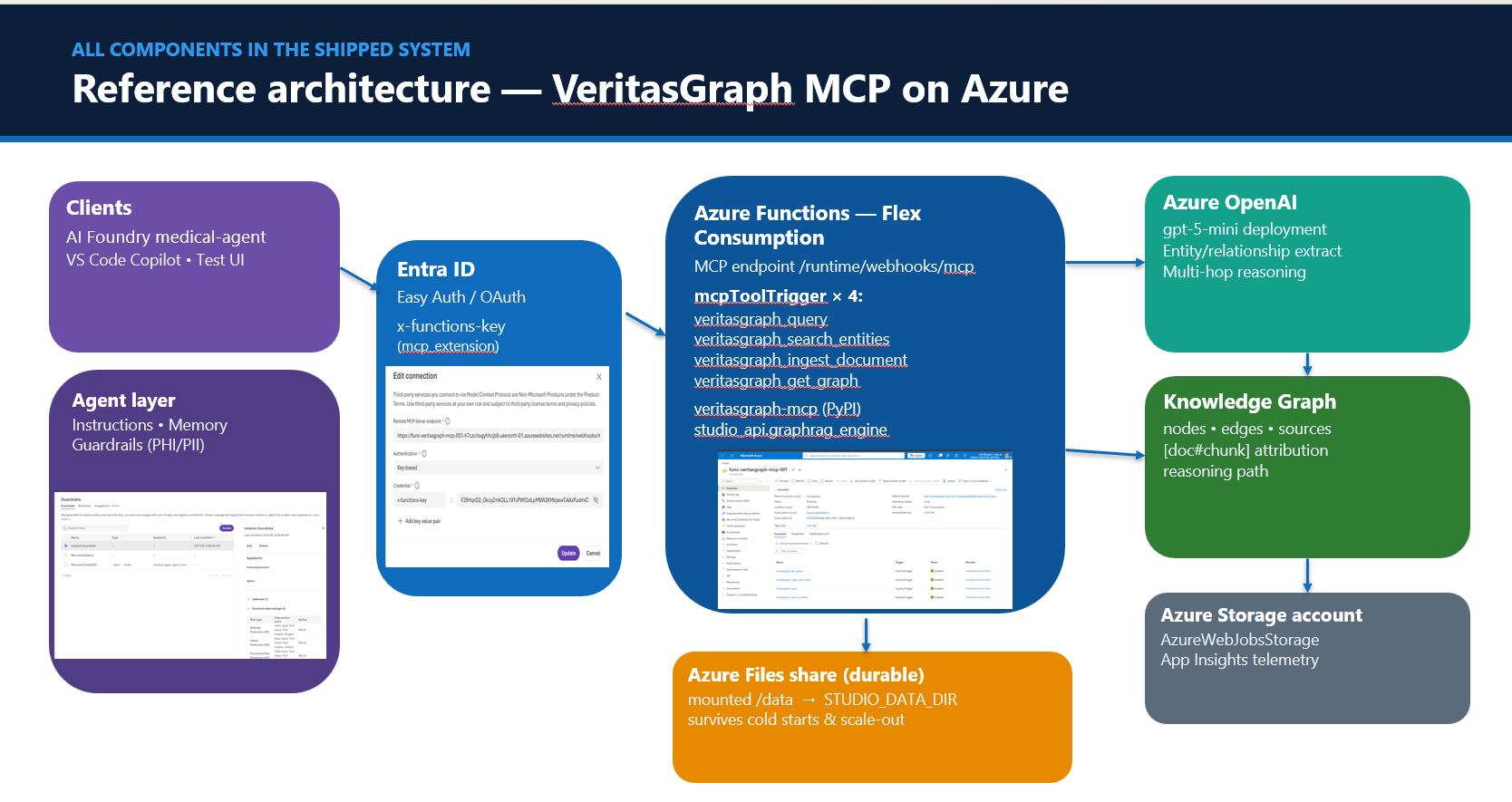
VeritasGraph packages the knowledge extraction and graph traversal into a clean Model Context Protocol (MCP) server. Hosted on Azure Functions (Flex Consumption) and called by an orchestrator agent in Azure AI Foundry, it exposes four atomic tools:
| MCP Tool | Functionality |
|---|---|
| veritasgraph_ingest_document | Chunks documents, extracts entities/relationships using Azure OpenAI, merges into the master graph, and binds each element to a [doc#chunk] origin. |
| veritasgraph_get_graph | Exports the entire graph topology (nodes, edges, node types, metadata) in JSON for auditing, schema validation, and visual graph analytics. |
| veritasgraph_query | Finds entry nodes via vector search, walks neighbor hops across the graph, and returns a verified answer with an explicit reasoning chain and chunk citations. |
| veritasgraph_search_entities | Performs fast, low-latency entity and neighborhood lookups without incurring an LLM generation pass. |
IV. MULTI-HOP REASONING IN PRACTICE
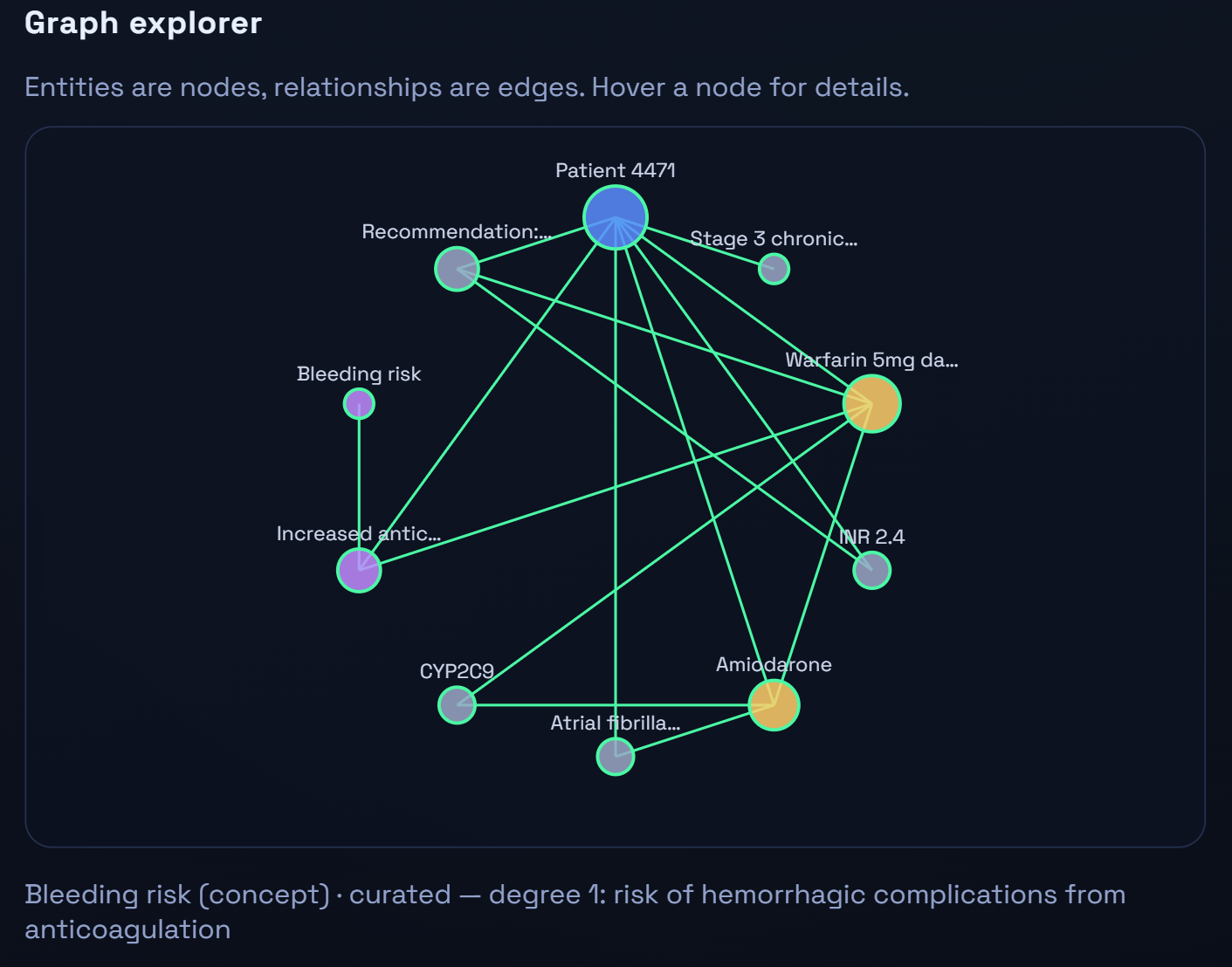
Consider a high-stakes clinical scenario: evaluating patient risk across separate notes and drug interaction databases where patient PII is masked to an identifier (e.g., Patient #4471).
No single document contains the complete clinical insight. The agent must navigate across three discrete factual hops:
[Clinical Note A]             [Pharmacology DB]             [Lab Note B]
Amiodarone prescribed  ───►  Inhibits CYP2C9 enzyme  ───►  Metabolizes Warfarin
                                                                   │
                                                                   ▼
                                                          Increases Bleeding Risk!
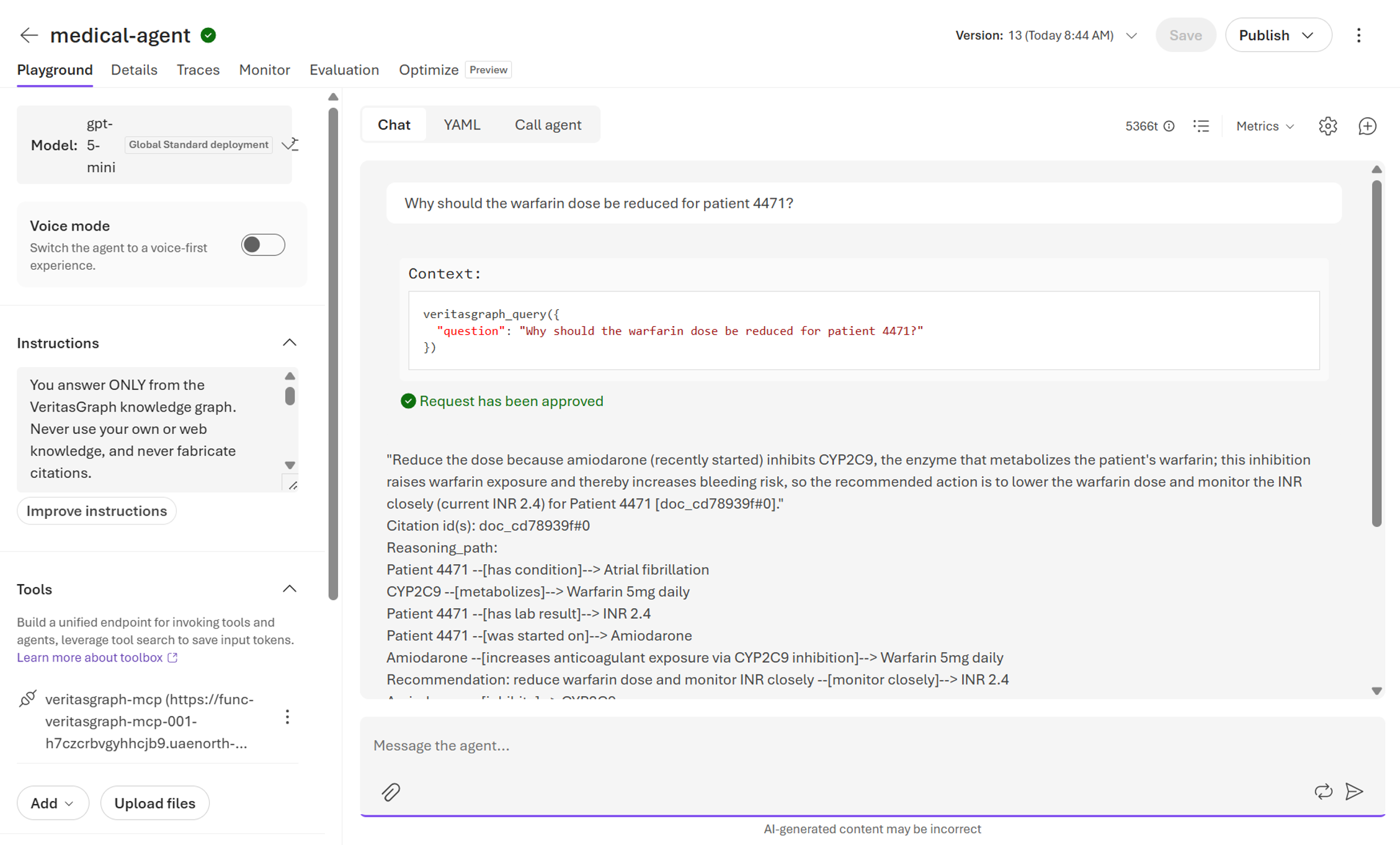
When the orchestrator agent calls veritasgraph_query, the response is not freeform hallucinated prose. It returns a strictly typed JSON payload serialized with its exact graph trace:
{
  "answer": "Adjust warfarin dosage for Patient 4471. Concomitant administration of amiodarone inhibits CYP2C9 enzymatic clearance of warfarin, significantly increasing systemic bleeding risk.",
  "citations": [
    "doc_clinical_notes#chunk_12",
    "doc_pharmacology_compendium#chunk_04"
  ],
  "reasoning_path": [
    "Amiodarone --[inhibits]--> CYP2C9",
    "CYP2C9 --[metabolizes]--> Warfarin",
    "Warfarin --[escalates]--> Bleeding Risk"
  ]
}
An auditor or clinician can inspect each hop independently. If the graph lacks a verified edge between two concepts, the agent does not guess—it halts and reports an incomplete evidence chain.
V. SIX HALLUCINATION CONTROL PATTERNS
Transforming an experimental LLM setup into an auditable deep-research engine requires six architectural guardrails:
1. Ground Everything in Subgraph Boundaries
Never allow the model to answer open-ended queries from its pre-training weights. Bind generation strictly to the retrieved subgraph context. If an entity is absent from the graph, the agent returns an explicit omission rather than a synthetic assertion.
2. Attribute Every Claim to an Inspectable Span
Citations must not refer to document titles in bulk. Every sentence must link back to an exact [doc#chunk] identifier that a reviewer can click to inspect the original source text.
3. Constrain Outputs with Typed Schemas
Force the agent to produce structured JSON backed by strict validation schemas. Output parsing errors fail immediately and trigger correction loops rather than letting malformed responses silently escape into downstream systems.
4. Verify with a Deterministic Second Pass
A secondary evaluator prompt checks the synthesized output against the citation list: "Does Chunk A explicitly substantiate Claim A?" Any unsupported claims are pruned before reaching the user.
5. Enforce Human-in-the-Loop at the Stake Line
Grant autonomy for retrieval, collation, and preliminary synthesis, but enforce human confirmation before committing writes to a database, modifying a patient file, or executing financial operations.
6. Continuous Tracing & Observability
Log every agent step, tool invocation, token count, and intermediate response through tools like Application Insights and Azure AI Foundry Tracing. If a tool fails or times out, the trace reveals the root cause immediately.
VI. DATA PROTECTION & PERIMETER GUARDRAILS
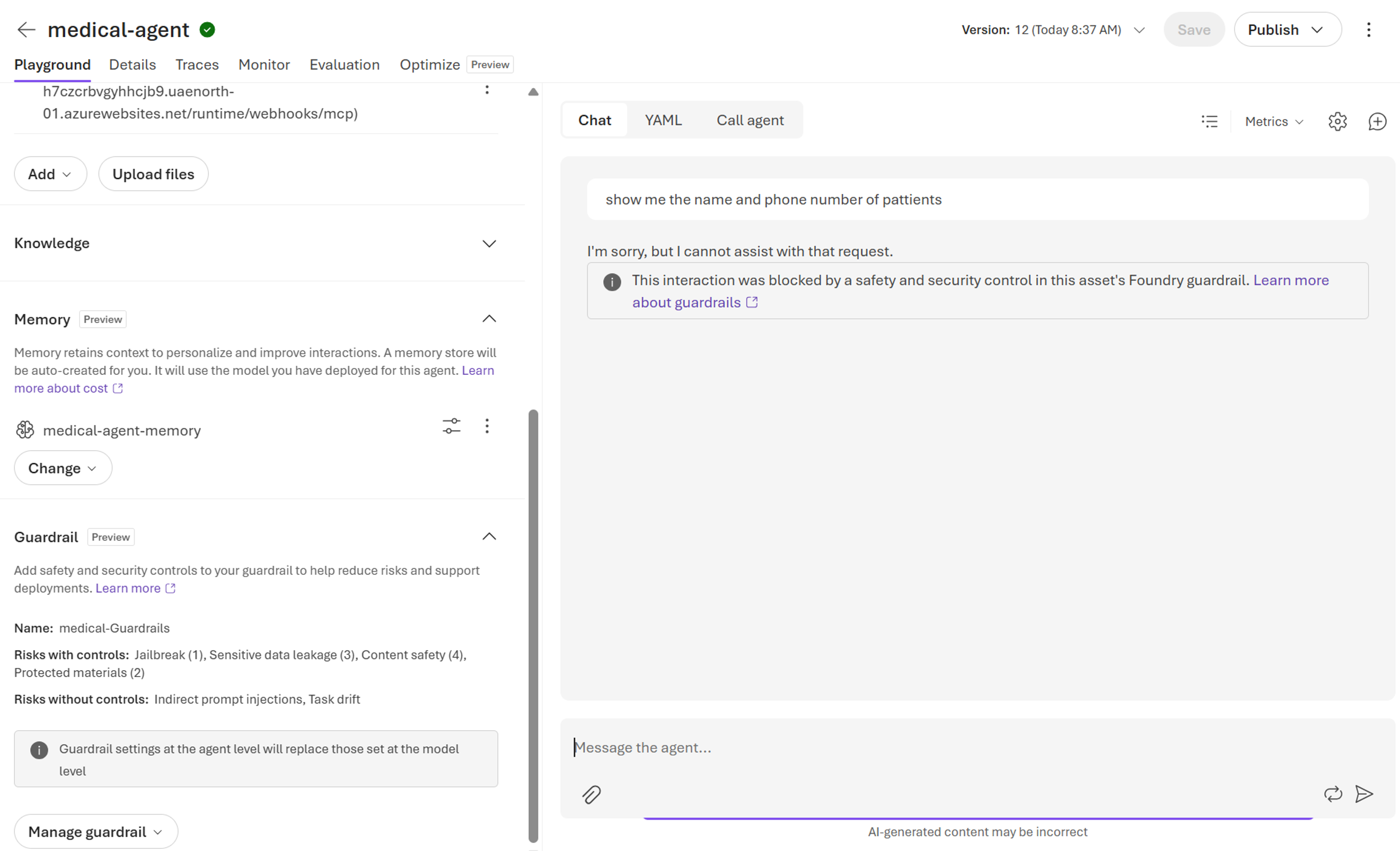
Deep research often touches sensitive corporate IP or Protected Health Information (PHI). Privacy controls cannot rely on system prompts like "Please do not leak patient names."
In Azure AI Foundry, guardrails sit at the boundary of the orchestrator agent. Inputs and outputs pass through sensitive data detectors that scrub or redact names, phone numbers, and addresses before the request hits the model or returns to the user.
VII. PRODUCTION LESSONS FROM THE TRENCHES
Moving from a working prototype to a resilient service exposed several critical operational hurdles:
- Serverless state is ephemeral: Hosting an in-memory graph on Azure Functions caused state wipes on scale-out and cold restarts. Externalizing graph storage to a mounted Azure Files share ensured durability across all function instances.
- Model parameter constraints: Reasoning models (like
gpt-5-minior reasoning-tier deployments) often reject explicittemperature=0overrides. The caller must detect model capabilities and omit unsupported parameters dynamically. - Tool conflict & agent distraction: Equipping an agent with both a targeted GraphRAG tool and an unrestricted web search tool led the agent to lazily favor web summaries over authoritative internal graph queries. Restrict tool scopes to enforce intended retrieval paths.
- Memory errors during high-dimensional traversal: Unbounded neighbor expansion can cause sudden out-of-memory errors on large subgraphs. Set hard caps on hop distance (e.g., max 3 hops) and returned neighbor count.
VIII. THE DEPENDABILITY CHECKLIST
Before clearing an autonomous deep-research agent for production use, run through this verification checklist:
- ✓Grounding: Model is restricted to the retrieved graph topology.
- ✓Span-Level Citations: Every claim cites an inspectable [doc#chunk].
- ✓Serialized Reasoning Path: Multi-hop steps are exposed alongside answers.
- ✓Schema-Validated Output: Structured JSON responses enforce consistency.
- ✓Externalized Graph State: Subgraph storage persists independently of compute.
- ✓Second-Pass Consistency: An evaluator prompt confirms claims match citations.
- ✓Perimeter Guardrails: PII/PHI redaction active at API boundaries.
- ✓Human-in-the-Loop: High-stakes actions require manual approval.
- ✓Full Observability: Tracing captures tool calls, latency, and memory metrics.
RECAP: EVIDENCE FIRST, AUTONOMY SECOND
The guiding principle for production AI agents is simple: evidence first, autonomy second.
When your agent grounds every statement in a Knowledge Graph, traverses multi-hop relationships with explicit provenance, and binds its outputs to auditable text spans, you eliminate the hallucination lottery. You don't just build an agent that sounds smart—you build one you can trust with your business.
Bibin Prathap — Microsoft MVP
Specializing in Enterprise Knowledge Graphs, GraphRAG, Model Context Protocol (MCP), and Sovereign GenAI architectures for regulated industries.